
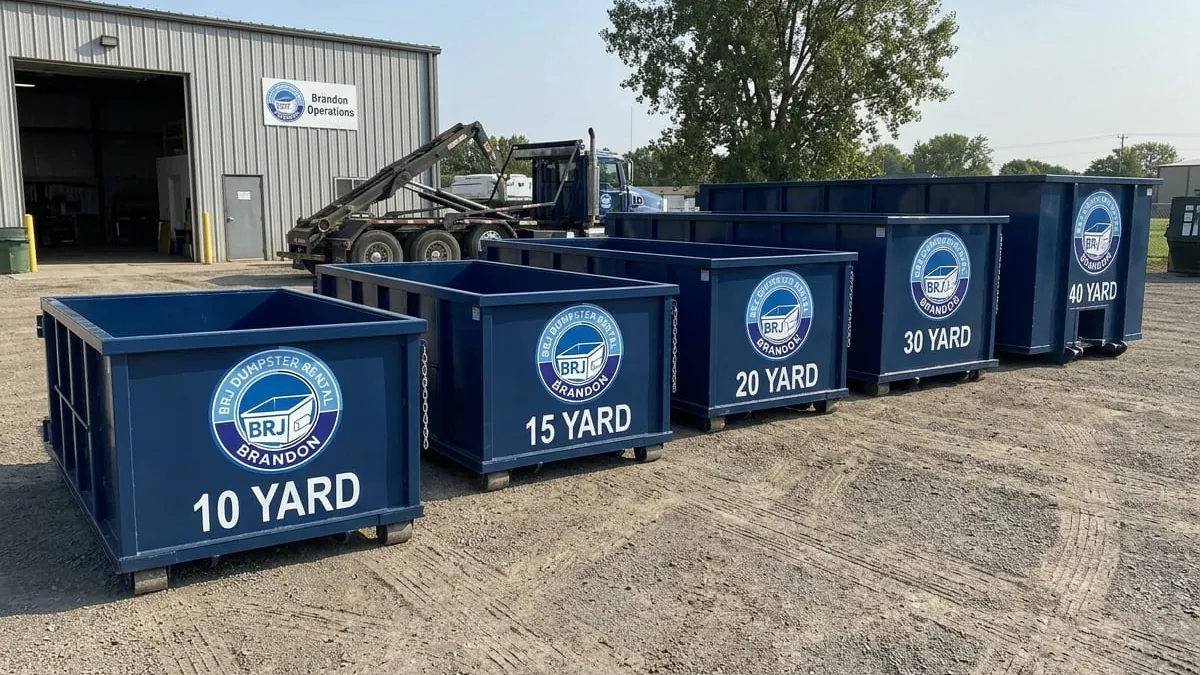
Compare all five sizes
Dumpster Sizes in Brandon, FL — 10, 15, 20, 30 & 40 Yard
Five roll-off sizes, and the honest version of which one you actually need. In Hillsborough County two things decide it: what the debris weighs — broken concrete, block, brick, roof tile and anything that has been rained on all run heavier than they look — and what the container is standing on, because Myakka fine sand over a water table a foot and a half down decides where a box can be set long before volume does.
All sizes
Pick by weight first, volume second
Scroll the table on mobile. If your load includes concrete, block, brick, roof tile, wet drywall or anything that has sat out in a storm, start at the 10 yard no matter how big the job looks — weight fills those long before volume does. Sizing charts written for somewhere else miss two things about this county. The first is the ground. There is no frost requirement here at all: Hillsborough County’s own residential structural design criteria checklist lists wind speed, risk category, roof and floor loads, pressure coefficients and exposure category, and nothing whatever about frost. What it has instead is Myakka fine sand, Florida’s state soil since 1989, which the USDA rates “very poorly or poorly drained” with a water table under 18 inches for one to four months in most years — so in the wet season the lawn is not somewhere to park several tons. The second is the housing. Brandon is a 1970s boom suburb: it went from 12,749 people in 1970 to 41,826 in 1980, a 228 percent decade, then on to 114,626 by 2020 with only about 11 percent of that added through the 2010s. The growth moved on and the housing stayed, so the market is now working through its first serious renovation cycle. These are slab-on-grade houses with no basement and no crawlspace, which means the garage, the lanai and the shed hold everything a northern house would put underground — and clearing them out is the single most common job we size a container for.
| Size | Capacity | Footprint | Weight allowance | Holds about | Best for |
|---|---|---|---|---|---|
| 10 Yard Dumpster | 10 yd³ | 12 ft x 8 ft x 3.5 ft | 2 – 3 tons | ~3 pickup truck loads | Concrete, block, roof tile and wet debris — and more than the County’s whole free yearly bulky allowance. |
| 15 Yard Dumpster | 15 yd³ | 16 ft x 8 ft x 4 ft | 2 – 3 tons | ~4 – 5 pickup truck loads | A single room, a small tear-off, or a two-car garage cleared to the walls. |
| 20 Yard Dumpster | 20 yd³ | 22 ft x 8 ft x 4.5 ft | 3 – 4 tons | ~6 – 8 pickup truck loads | A whole-house declutter — the Brandon default — or a multi-room remodel. |
| 30 Yard Dumpster | 30 yd³ | 22 ft x 8 ft x 6 ft | 4 – 5 tons | ~9 – 12 pickup truck loads | A large remodel or a full estate cleanout, garage and lanai included. |
| 40 Yard Dumpster | 40 yd³ | 22 ft x 8 ft x 8 ft | 5 – 6 tons | ~12 – 16 pickup truck loads | Commercial gut jobs and construction — it needs the most room to set down. |
10 Yard Dumpster
Concrete, block, roof tile and wet debris — and more than the County’s whole free yearly bulky allowance.
View this size → 15yd³15 Yard Dumpster
A single room, a small tear-off, or a two-car garage cleared to the walls.
View this size → 20yd³20 Yard Dumpster
A whole-house declutter — the Brandon default — or a multi-room remodel.
View this size → 30yd³30 Yard Dumpster
A large remodel or a full estate cleanout, garage and lanai included.
View this size → 40yd³40 Yard Dumpster
Commercial gut jobs and construction — it needs the most room to set down.
View this size →The two rules that decide it here
Weight beats volume on dense material, and the surface under the wheels beats both
This is the single most useful thing on the page. A container has two limits: how much volume it holds and how much weight a truck can legally lift and carry. Light debris runs you out of volume first. Dense material runs you out of weight first, and it happens far earlier than people expect.
Around Hillsborough County the dense material is broken concrete, block, brick, roof tile and anything soaked. Concrete and block run in the range of 2,400 to 2,800 lbs per cubic yard — a front walk, a patio slab, a section of pool deck or an old carport pad reaches legal transport weight in a can that still looks half empty. Barrel and concrete roof tile is the one people misjudge most here, because a tile roof is masonry by another name and it is priced and hauled like masonry. Roofing generally is measured in squares and layers, never in roof area, and it is common to find a second course still sitting on the deck, which doubles the tonnage on a roof that looked like a one-can job. Rain is the other quiet weight. Through the June to September convective season an open container left uncovered through one afternoon storm takes on water, and water is weight you pay to haul. Worth knowing too: lead-acid batteries are barred from disposal under § 403.708(12), Fla. Stat., and because this county sends its household waste to a waste-to-energy plant rather than straight to a landfill, that ban covers the burner as well as the landfill. Clean concrete and masonry are worth keeping as their own load. In a county that takes “burnable waste only,” they are non-processable, they are priced differently for it, and a mixed load carries a 2× surcharge.
The second rule is the one sizing charts written for other states never mention. The surface under the container decides as much as the size of it. This county is flat, so grade is rarely the problem — the problem is what the ground does when it is wet. On Myakka fine sand over a water table that sits under 18 inches for one to four months in most years, several tons on four small contact points will settle into a lawn or an unpaved verge in the wet season and stay there. Driveway, not grass, and plywood under every wheel and under both rails, on every placement, all year round. The loading rule that goes with it is simple: load flat, load low, heavy on the bottom, nothing standing proud of the top rail — because a load standing proud cannot be tarped, a load that cannot be tarped cannot legally be hauled, and in this climate it will not stay dry long enough to argue about. Where the 30 and the 40 yard earn their keep is bulk with no weight in it — a shed, screen enclosure or detached garage teardown, a whole-house cleanout, a garage and lanai emptied after thirty years — with room to work. Pull the scrap metal and the flattened cardboard out first, because both have a route of their own and both are cheaper out of the box than in it.
Tell us the material, the rough quantity and what the driveway looks like on the phone and we will size it properly. Getting it wrong costs us more than it costs you, so we have every reason to get it right.
How it works
From phone call to empty driveway
- 1
Call us
Tell us the project, your address and when you want it. Two minutes on the phone and you have a flat price.
- 2
We deliver
Our driver walks the drop, lays protection boards and sets the container exactly where you want it.
- 3
You load it
Take your time within your rental window. Keep it level with the top rail and we handle the rest.
- 4
We haul it
Call or text when you are done. We pull it, sort what can be recovered and dispose of the rest properly.
Choosing a Size — FAQs
Which dumpster size is most popular in Brandon?
The 20 yard, by a wide margin. It handles a garage and lanai cleared out in one go, a kitchen gut or a multi-room remodel, and it still sits on an ordinary Brandon driveway. The 15 yard is next most common because it is the sweet spot for a single room, one unit of a rental turnover or a shingle tear-off on an average house. Anything with concrete, block, brick, roof tile or soaked debris in it goes the other way, down to a 10 yard. For scale on the small end: the county’s free bulky allowance at a Community Collection Center is 10 cubic yards a year, and you have to unload it by hand. The smallest box we run is more than that in one afternoon.
What size do I need for a roof tear-off?
For a Brandon house on asphalt or dimensional shingle, a 15 or 20 yard. Roofing is weight-driven rather than volume-driven, so squares and layers decide it, not roof area — and it is common to find a second course still sitting on the deck, which doubles the tonnage. Barrel or concrete tile is a different animal entirely. That is masonry, and it belongs in a 10 yard, often twice. Who pays for the haul is a local question and the answer here is short: the county does not collect construction and demolition debris, so a tear-off is on the contractor or on you. There is also a placement point worth planning around, and it is not the one you will read elsewhere. Florida works from NFPA 1, not the International Fire Code. The Florida Fire Prevention Code, 8th Edition, effective 31 December 2023, adopts NFPA 1 with the 2021 edition as its base under § 633.202, Fla. Stat. So the “10 feet from the building” line on the national blogs is not the rule here. What the code requires, at NFPA 1 Chapter 19, 19.1.2, is that “combustible waste cannot be allowed to build up inside or outside the building in any manner that will pose a fire hazard” — a performance requirement rather than a published distance, so we will not print a distance and call it code. We keep boxes clear of the house, the eaves, the meter and the AC condenser as a matter of practice. Older roofing felt, mastic and cement-asbestos shingle can contain asbestos, which stops the job until it is tested; in Hillsborough that notification goes to the Environmental Protection Commission of Hillsborough County rather than to the state, with at least 10 working days’ notice and the survey attached. Our tear-off sizing guide has the full math.
Is the 40 yard just the biggest and best?
No, and treating it that way is an expensive mistake. The 40 yard is a volume container for bulky light debris — framing, cabinetry, screen enclosure aluminum, packaging and whole-house cleanouts. Put anything dense in it and you will pass legal transport weight long before it is full. It also needs the most room of anything we run, which rules it out on plenty of the 1970s and 1980s Brandon streets with short driveways and tight turning space, and on any lot where the only flat ground is lawn rather than slab. A big open box of light material has to be loaded below the rails and covered, or one afternoon storm fills it with weight you pay to haul and the wind puts the rest down the street. Where room is tight we will usually put two smaller boxes through rather than one 40, and it works out better for everyone.
Can I change size after I book?
Yes, as long as the truck has not been dispatched. If you describe the job and we think you have ordered wrong, we will say so before delivery rather than after. Changing on the phone costs nothing; discovering it at the scale house costs a great deal.
How much space do I need?
Roughly the container footprint plus working room: about 60 feet of straight approach for the truck, around 10 and a half feet of width, and 20 feet or more of overhead clearance while the hoist operates. Surface matters as much as space here. Tell us whether the spot is driveway slab, pavers or grass, and whether it holds water after a storm, because on Myakka fine sand a wet verge will not carry a loaded box and the driveway will. On fire code, the number you have probably read is wrong for this state. Florida works from NFPA 1, not the International Fire Code, so the “10 feet from the building” rule is an IFC number that does not apply here. NFPA 1 Chapter 19, 19.1.2 requires that combustible waste not be allowed to build up inside or outside a building in any manner that will pose a fire hazard — a performance requirement, not a published distance, so we will not print one and call it code. We place clear of the house, the eaves, the meter and the AC condenser, and we keep hydrants, exits and fire apparatus access clear. No fire permit for placing a container appears in the county fire marshal’s fee schedule. Look up before you decide: a live oak limb, a porch roof, a low gutter or the service drop into the house will stop the arm cold.
Services
What people put in them
Residential Dumpster Rental
Driveway placement for the garage, lanai and shed cleanouts a slab-built house produces.
Learn more →Commercial Dumpster Rental
Containers for businesses and contractors — the County does not collect construction debris.
Learn more →Construction Dumpster Rental
Mixed C&D in one roll-off, with next-day swap-outs across Hillsborough County.
Learn more →Roofing Dumpster Rental
Weight-rated cans sized by squares and layers, tarped against the afternoon rain.
Learn more →Roll-Off Dumpster Rental
10, 15, 20, 30 and 40 yard roll-offs across Brandon and Hillsborough County.
Learn more →Same-Day Dumpster Rental
Call before the cut-off and we can usually get a container to you this afternoon.
Learn more →Talk to a real person
Not sure which size you need?
Tell us what you are clearing out and we will tell you the right size and the flat price to put it in your driveway. No forms, no waiting on an email — just call and we will sort it out in a couple of minutes.
Serving Brandon, Hillsborough County and the Tampa Bay area · Mon–Fri 6:30am–5pm, Sat 7am–1pm