
Roofing
Roofing Tear-Off Dumpster Size Guide for Brandon, Florida
Shingles do not take up room, they take up tonnage. Here is how to size a tear off container in Brandon, why tile needs its own box, and what the summer rain does to the scale ticket.
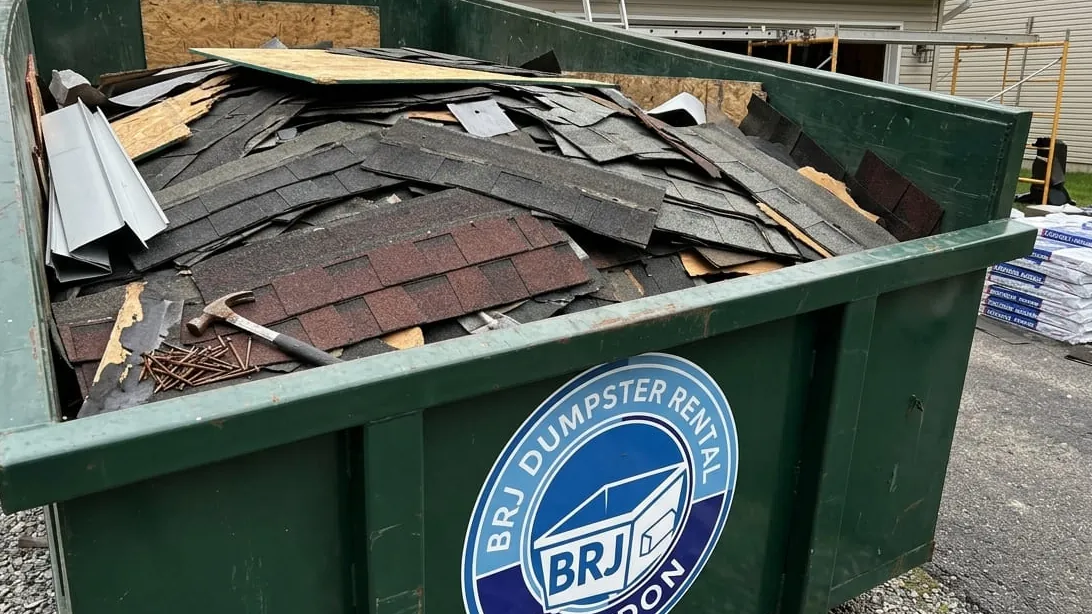
A roof tear-off is the job where sizing a container by eye fails hardest. Shingles do not take up much room. They weigh an enormous amount. Fill a 20-yard box with them and you have built something a truck cannot legally lift off your driveway.
So the roofing conversation is a weight conversation from beginning to end, and in Brandon it has a second variable most of the country does not deal with: for four months of the year, an uncovered container is also collecting rain.
Roofing is a weight problem, not a volume problem
Every container has two limits. One is the physical volume of the box. The other is the weight the truck can legally carry on the road. For almost every kind of debris, you hit the volume limit first — furniture, cabinetry, packaging, yard waste all run out of room long before they run out of tonnage.
Roofing reverses that. Tear-off material is dense, flat and stacks perfectly, so it uses volume efficiently and adds weight the entire time. A box that looks a third full can already be at the weight limit.
That is why the roofing container is almost always a 10 or a 15, not a 20 or a 30. The smaller box is not a smaller job. It is the box sized to reach its weight limit and its volume limit at roughly the same moment.
Counting the job in squares and layers
Roofers measure in squares. One square is 100 square feet of roof surface. A common Brandon single-story house from the boom years runs somewhere in the twenties of squares, and a larger two-story or a house with a lot of hips and valleys goes up from there.
Then multiply by layers. A roof carrying two layers of shingle produces twice the tear-off of the same roof carrying one, and older Brandon houses on their third roof sometimes have more up there than anybody expected.
Rough weight, as a planning figure only
Weights vary by product, by manufacturer and by how wet the material is, so treat these as planning ranges rather than promises, and give us the real numbers when you call.
| Material | Approximate weight per square | Notes |
|---|---|---|
| Three-tab asphalt shingle | Roughly 200 to 250 lb | Lighter, older product, common on original roofs |
| Architectural or laminate shingle | Roughly 250 to 400 lb | Heavier, and the usual replacement product |
| Concrete or clay tile | Several times shingle weight | The heaviest common roof covering here |
| Underlayment, felt, flashing, drip edge | Small by weight, awkward by volume | Adds up on a big roof |
| Wet material of any kind | Meaningfully more | Water is weight you pay to haul |
Run the arithmetic on a mid-size Brandon roof at two layers of architectural shingle and you can see why the answer is a small box. The volume is unremarkable. The tonnage is not.
How to actually count your own roof
You do not need a roofer to get within range. Take the footprint of the house in square feet, add the garage and any covered lanai under the same roof line, and add roughly fifteen to twenty-five percent for pitch depending on how steep it is. Divide by 100 for squares. Then look at the edge of the existing roof at a rake or a valley and count the layers you can see. That number is usually good enough for us to put the right box on the truck.
The thing that throws the estimate is complexity, not size. A simple gable roof tears off cleanly. A house with three or four different roof planes, dormers, a lanai addition and a re-roofed garage from a different decade will produce more material than the square footage suggests, because every transition means extra flashing, extra underlayment and often an extra layer nobody knew about.
Tile is its own calculation
Concrete and clay tile roofs are common enough in this part of Florida that they need saying separately. Tile is heavier than shingle by a wide margin, and it is inert — it does not burn.
That second point matters more here than almost anywhere. Hillsborough County’s disposal system is built around a waste-to-energy plant that accepts “burnable waste only,” which is why the county’s rate schedule separates processable from non-processable waste. Tile is firmly in the second category, and a container of tile is not going to the same destination as a container of shingle.
Practical version: do not mix a tile tear-off with anything else. The county applies a surcharge of two times the posted rate on mixed loads. Tile goes in its own small box, loaded flat across the floor, spread rather than piled at one end.
Four months when an open box fills with water
Roughly two-thirds of this area’s annual rainfall arrives between June and September, in near-daily afternoon convection. The forecast office for this area is the National Weather Service at Ruskin, and their outlooks are worth checking before a tear-off week — they publish at weather.gov/tbw.
Here is the part that costs money. An open-top container has a large flat footprint. Shingles at the bottom of a box do not drain, they hold. Felt and underlayment soak. Whatever water goes in stays in until the box is dumped, and disposal is billed by the ton.
Three habits fix most of it:
- Tarp the container whenever the crew is not actively loading it. Not just overnight. Between the last load of the morning and the first of the afternoon, in August, is enough time.
- Do not let a full box sit through a wet weekend. Schedule the haul for the day the tear-off finishes, not the following Monday.
- Get wet material out first. If a section came off soaked, it should not be the layer sitting under everything else for four days.
This is the Florida equivalent of the snow-load problem northern crews plan around, except it recurs every afternoon for four months rather than a few times a winter. More on how weight drives the invoice in our Brandon cost article.
Brandon roofs are on their second or third covering
The local context explains why we do so many of these. Brandon went from 12,749 people in 1970 to 41,826 in 1980, a 228 percent decade, then filled in and effectively stopped growing — up only about 11 percent through the 2010s to 114,626 in 2020.
A house built in that boom is forty to fifty-plus years old. It is on its second or third roof, and the tear-off is frequently part of a bigger insurance-driven or sale-driven push that also involves windows, soffit and fascia. Plan the container for the whole scope, not just the shingles, or you will be calling for a second box on the Wednesday.
Riverview, ten minutes south, is a different market entirely — it grew 490.4 percent between 2000 and 2010, so those roofs are much younger. Two housing vintages side by side, and two different roofing conversations.
Loading a roofing container so it can leave
Two rules cover almost everything. Spread the material and stay under the rails.
Spreading matters because a pile at the door end of the box puts the whole load on one axle when the truck lifts it, and because a heaped end is what stops a tarp from going over cleanly. Working from the far end toward the door, in flat layers, uses the box properly and keeps the weight even.
Staying under the rails is not a preference. A load heaped above the top edge cannot be legally covered or transported, so it has to be pulled down and redistributed before the truck can take it. That is a delay in the middle of a job that had no time in it to begin with. If the box is filling faster than the roof is coming off, call for the swap then, not at the end of the day.
Placement, and protecting what is under the box
A loaded roofing container is among the heaviest things that will ever sit on a residential driveway, concentrated on a small number of contact points.
The ground here does not help. Brandon sits on Myakka fine sand, Florida’s official state soil since 1989, formed in sandy marine deposits and classed by the USDA as very poorly to poorly drained, with a water table less than 18 inches down for one to four months in most years. That saturated window is the same rainy season the tear-off is happening in.
So: driveway, not lawn, and not the swale. Plywood or planks under the wheels and rails to spread the load and protect the concrete. Position the box on the tear-off side of the house so the crew is not carrying material around the building, and keep it clear of the eave line, the electrical meter and the air conditioning condenser.
Magnetic sweep, every day
Roofing nails end up in driveways, lawns and tires. Run a magnet over the drive and the approach at the end of each day, not only at the end of the job. It costs ten minutes and it prevents the one complaint that outlives every roofing project.
What comes off with the roof, and what cannot go in the box
A tear-off is rarely only shingles. Expect underlayment, drip edge, flashing, ridge vent, sometimes rotten decking, sometimes an old skylight, sometimes a satellite dish nobody has used in fifteen years. All of that is fine in a roofing container.
What is not fine:
- Anything containing asbestos. Older roofing products and mastics can. If asbestos is suspected, it gets surveyed and abated, and in Hillsborough County the notification goes to the county’s own environmental commission, not to the state. Not our container, not our advice.
- Lead-acid batteries, barred by Florida statute from landfills and from waste-to-energy facilities alike.
- Sealants, solvents, adhesives and roof coatings in liquid form. Household hazardous waste, collected by the county on rotating Saturdays.
- Propane tanks or any pressurized vessel.
County disposal rules and collection schedules are published on hcfl.gov.
Decking is the variable nobody budgets for
On a Brandon house that has been through two or three roofs, some of the plywood or board decking underneath is usually going too. You do not know how much until the shingles are off, which means the container has to have headroom in the plan even though the estimate was written for shingles alone. Rotten decking is bulky, light and wet, and it is the single most common reason a roofing job needs a swap that was not scheduled.
Booking around a tear-off day
Tear-off is a compressed job. The roof is open, and everything is timed to closing it back up before the afternoon storm.
That means the container needs to be in place the evening before, not the morning of. It means the swap needs to be scheduled when you book, not when the box fills. And it means telling us the material and the square count on the first call, because a tile roof and a shingle roof are not the same order.
Details on the equipment and turnaround are on our roofing container page, and dimensions are on the sizes page. To set one up, call BRJ Dumpster Rental Brandon at (813) 773-2486. We have been doing Brandon tear-offs out of Parsons Avenue since 2013, and we will tell you honestly if the box you asked for is the wrong one.
Questions this guide did not answer? Call (813) 773-2486. We would rather spend two minutes on the phone than have you order the wrong container.