
Construction
Construction Debris Disposal in Florida: The Brandon Rules
The county does not collect renovation debris, asbestos notices go to a county agency rather than the state, and mixed loads carry a doubled rate. What a Brandon jobsite needs to plan for.
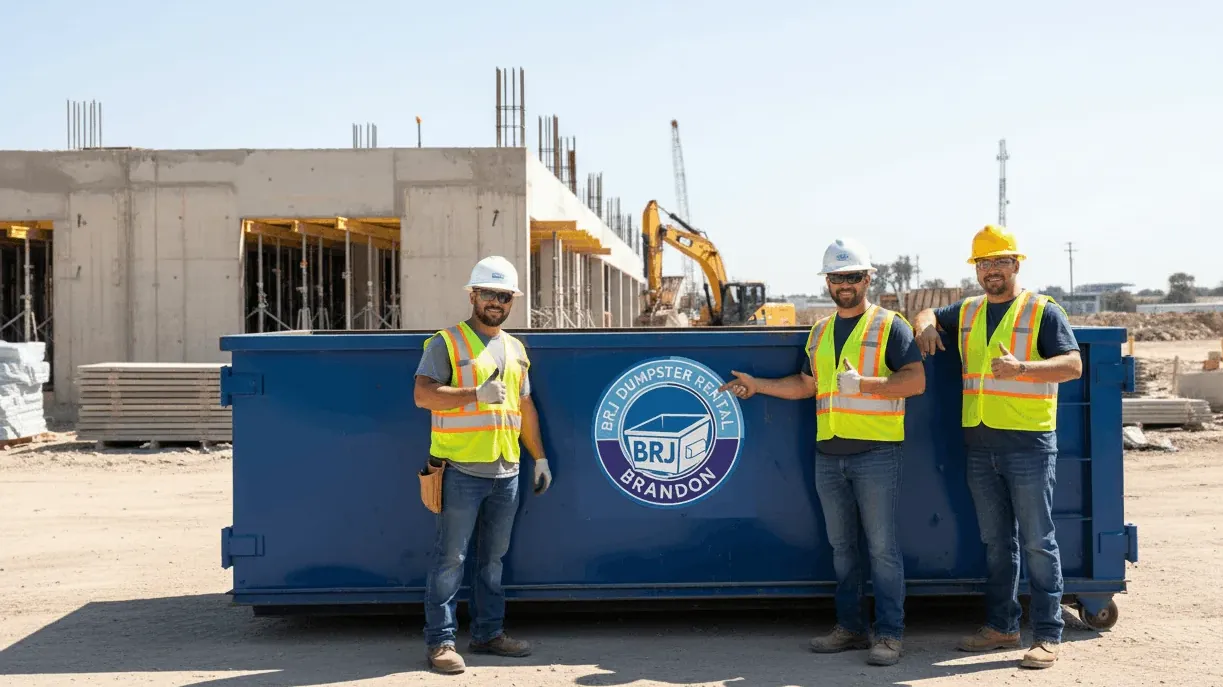
Construction and demolition debris is its own category in Florida, with its own rule, its own disposal path and its own set of ways to get it wrong. In Hillsborough County there is an extra layer on top, because the county regulates some of this itself rather than handing it to the state.
Here is what a contractor or a homeowner running a renovation in Brandon actually needs to know, in the order it usually comes up.
Start here: the county does not collect it
Hillsborough County does not collect construction and demolition debris. There is no curbside category for it in unincorporated Hillsborough. Drywall, cabinets, flooring, tile, framing lumber, roofing, windows and doors are simply outside the residential collection system.
Nor does C&D appear on the published acceptance list for the county’s five Community Collection Centers, where the free bulky allowance is 10 cubic yards per household per year and the county states plainly that “bulky waste must be self-unloaded by hand. No dump trailers allowed.”
And if you are working for money, the residential system is closed to you regardless. The county is explicit that commercial businesses, including landscaping and tree services, are “not able to use residential folio accounts” and pay standard tipping fees. A contractor cannot dispose of a job’s debris on a homeowner’s residential account. That is not a gray area.
Which leaves a container, and a plan for what goes in it.
What counts as C&D, and the rule that governs it
Statewide, C&D debris is defined in Rule 62-701.200(24) of the Florida Administrative Code as discarded materials generally considered not water soluble and non-hazardous, arising from construction, demolition or renovation. The named materials include steel, glass, brick, concrete, asphalt, pipe, gypsum wallboard and lumber, along with land-clearing vegetation, clean cardboard and untreated wood scrap when properly separated.
Disposal and recycling of that material is governed by Rule 62-701.730, “Construction and Demolition Debris Disposal and Recycling,” which also requires facilities to report recycled and disposed tonnage annually, by the county where the debris originated.
Florida DEP notes that C&D makes up close to a quarter of the state’s total waste stream. It is not a niche category.
The sentence that decides your disposal cost
DEP is direct about this: mixing C&D debris with other solid waste types causes it to lose its C&D classification. Once it loses that classification it is no longer handled or priced as C&D.
Hillsborough County reaches the same conclusion from the other end, applying a surcharge of two times the posted rate on mixed loads in its published disposal schedule. A state rule and a county price list, agreeing that a clean load is worth keeping clean.
Why the sorting matters more here than in most counties
Hillsborough burns its garbage. The county-owned Resource Recovery Facility at 350 North Falkenburg Road takes up to 1,800 tons a day, generates around 47 megawatts, diverts roughly 80 percent from landfill and pulls about 19,600 tons of metal a year out of the stream. The county describes it as accepting “burnable waste only.”
Concrete, block, brick, rock, tile, dirt and aggregate are not fuel. They cannot go to a waste-to-energy plant, so they are routed elsewhere. That is why the county’s rate schedule splits waste into processable and non-processable categories at different per-ton rates.
The practical version for a jobsite: separate the inert material from everything else. Slab sections, tile and mortar, block and pavers belong in their own container, loaded flat and low. Framing, drywall, cabinetry, carpet and packaging are a different load with a different destination. Staging that properly is what a construction container is for.
How to split a renovation into loads
Most Brandon remodels produce three distinct streams, and knowing which is which before demolition day saves real money.
| Stream | Typical material | How to handle it |
|---|---|---|
| Inert and heavy | Concrete, block, brick, pavers, tile and mortar bed, slab sections, dirt | Its own container, usually a 10, loaded flat and low |
| Burnable bulk | Framing lumber, cabinetry, drywall, carpet, trim, packaging, doors | The larger box. Keep it dry |
| Neither | Paint, solvents, adhesives, batteries, tires, refrigerant appliances, asbestos | Out of the container entirely, each on its own route |
Deciding this at the start is worth more than deciding it at the scale house. If you are not sure which stream a material belongs in, ask before it goes in the box.
Asbestos: in this county the notification goes to the county
This is the detail out-of-area contractors miss most often, and it will stop a demolition.
The Environmental Protection Commission of Hillsborough County, the EPC, holds delegated air and asbestos authority. Hillsborough is one of only eight of Florida’s 67 counties that runs its own local air program with authority over asbestos notifications. In the other fifty-nine, the notice goes to Florida DEP. Here it goes to a county agency, on a county form, with county fees.
Who has to notify
The EPC’s trigger covers owners or operators planning renovation or demolition where the project involves a commercial structure, more than one single-family residential home, or multi-residential structures with more than four dwelling units. A single ordinary owner-occupied Brandon house being renovated on its own does not fall inside that trigger. That is worth knowing in both directions, because generic advice gets it wrong each way.
The lead time and the survey
Notification is due at least 10 working days before the scheduled start date, and a copy of the asbestos survey must accompany the notification for staff review. Ten working days is two calendar weeks. It goes in the schedule at the start, not the week before.
The fees
The EPC publishes a fee schedule in the range of $310 to $360 depending on project type, with commercial demolition and renovations between 160 and 1,000 square or linear feet at the lower figure and larger renovations at the higher one. Confirm current amounts with the agency at epchc.org before you budget them.
The county’s commercial demolition permit package requires the EPC form as an intake document, so the two processes are linked. Statewide, the backdrop rules are Chapter 62-257 of the Florida Administrative Code and licensing under § 469.004, Florida Statutes, which requires that asbestos consultants and contractors be licensed by the Department of Business and Professional Regulation.
Asbestos does not go in our containers. It gets surveyed, notified and abated by a licensed contractor, and it is disposed of through a facility that accepts it. That is the whole of our advice on the subject, and it should be the whole of any hauler’s.
Lead paint, pre-1978 houses, and who runs the program in Florida
Brandon’s housing boom was the 1970s. The population went from 12,749 in 1970 to 41,826 in 1980, a 228 percent decade. A large share of Brandon’s houses went up before the 1978 lead-paint cutoff, and those houses are now the ones being remodeled.
Federal law requires renovation, repair and painting firms working in pre-1978 housing, or facilities where children are routinely present, to be certified. Firm certification runs five years.
The part that surprises contractors moving here from other states: Florida is not an EPA-authorized RRP state. EPA administers the program directly for Florida contractors. There are authorized states that run their own version; Florida is not one of them. Your certification comes from EPA, not from a Florida agency, and individual renovators are certified through an EPA-accredited training provider.
For debris, the practical consequence is containment and handling on site. Lead-safe work practices govern how the material is bagged and moved before it reaches the container.
Two more things before the first swing
Call Sunshine 811
Florida’s one-call center is Sunshine State One-Call of Florida, Inc., established under § 556.103, Florida Statutes and branded Sunshine 811, operating under Chapter 556, the Underground Facility Damage Prevention and Safety Act. The statute, at § 556.105(1)(a), requires not less than two full business days notice. Not three. Any demolition, stump removal, post setting or excavation needs it.
Check who owns the road
Brandon has four road authorities: FDOT for State Road 60, signed Brandon Boulevard from I-75 to Mount Carmel Road; the Tampa Hillsborough Expressway Authority for the Selmon Expressway; the interstates; and Hillsborough County for everything else. The county right-of-way desk is Development Services on (813) 272-5600, not Public Works. The full picture is in our Brandon permits article.
Burying it on the property: legal, and still a bad idea
Florida statute does allow it. § 403.707, Florida Statutes exempts disposal of construction and demolition debris on the property where it was generated from the permit requirement, provided the site is covered, graded and vegetated as necessary when disposal is complete.
Now the other half. The Florida Geological Survey lists decomposing buried trash among the causes of ground subsidence that get mistaken for sinkholes. Hillsborough sits on a flat carbonate platform beneath sandy marine deposits, where karst expresses itself as closed surface depressions rather than caves, and where the state’s own reporting documents human-triggered events — including a 2010 pumping-related freeze-protection episode in Plant City that triggered sinkholes.
So: yes, the statute permits it. In a county the state already flags for human-triggered subsidence, burying a renovation in the back yard is a decision your grandchildren will meet. Put it in a container.
Loading a construction container in Brandon
Three local conditions change how a jobsite container should be run.
- The ground is sand. Myakka fine sand is Florida’s state soil, classed by USDA as very poorly to poorly drained, formed in sandy marine deposits, with a water table less than 18 inches down for one to four months in most years. A loaded container on unpaved ground in the wet season sinks. Set it on pavement, on plywood or on a prepared pad.
- It rains for four months. Roughly two-thirds of annual rainfall arrives June through September. An open box collects it, and disposal is billed by the ton. Wet drywall and wet insulation are the expensive part. Tarp anything that will sit.
- Load heavy low and flat. Inert material goes on the floor of the box, spread, not heaped. A load above the rails cannot legally leave the site.
For demolition work specifically, including the notification lead times that drive the schedule, see our demolition debris service.
What does not go in the container
Asbestos. Lead-acid batteries, which Florida statute bars from landfills and from waste-to-energy facilities alike. Paint, solvents, adhesives, fuels and pool chemicals. Refrigerant-bearing appliances until the refrigerant is recovered. Tires. Anything liquid.
Everything else is a conversation, and it is a short one. Tell us the trade, the square footage and the material, and we will tell you the box and how to stage it. BRJ Dumpster Rental Brandon, Parsons Avenue since 2013. (813) 773-2486.
Questions this guide did not answer? Call (813) 773-2486. We would rather spend two minutes on the phone than have you order the wrong container.